Hair Transplant Recovery: Week-by-Week Guide to Results
Nov 11, 2026
Hair restoration is an important decision, and understanding what happens after the procedure can make the experience much more comfortable. Hair Transplant Recovery: Week-by-Week Guide to Results explains how the scalp heals, when transplanted hair begins to shed, and how new growth develops over the following months. Although the procedure moves you closer to your hair restoration goals, the visible transformation takes patience, proper aftercare, and realistic expectations.A hair transplant does not produce a full head of hair overnight. The transplanted follicles need time to settle into their new location, while the surrounding scalp gradually recovers from the procedure. Some people notice redness and mild swelling during the first few days, while others experience temporary shedding in the following weeks. These changes are generally expected parts of recovery.Knowing what to expect at every stage helps you distinguish normal healing from symptoms that require medical attention. Whether you have undergone Follicular Unit Extraction (FUE) or Follicular Unit Transplantation (FUT), following your surgeon’s instructions is essential for protecting the transplanted grafts and supporting healthy growth.
What Happens During Hair Transplant Recovery?
Hair transplant recovery is the period during which the scalp heals and transplanted hair follicles gradually begin producing new hair. It involves two important processes: physical healing of the donor and recipient areas, and biological adaptation of the transplanted follicles.During the first few days, tiny wounds created during graft extraction and implantation begin to close. Small scabs may develop around the implanted follicles, and the scalp can feel tight, sensitive, or slightly uncomfortable. These symptoms usually improve as healing progresses.However, visible hair growth takes considerably longer. The hair transplant procedureshafts may shed during the first few weeks, but the follicles generally remain beneath the skin. They subsequently enter a resting phase before producing new strands.The exact recovery experience depends on several factors, including:– The number of grafts transplanted.– Whether the procedure was FUE or FUT.– Individual healing characteristics.– Existing scalp health.– The surgeon’s technique.– Compliance with postoperative instructions.– Smoking, nutrition, and other lifestyle factors.Understanding these differences is important because recovery timelines are not identical for everyone.
Hair Transplant Recovery: Week-by-Week Timeline
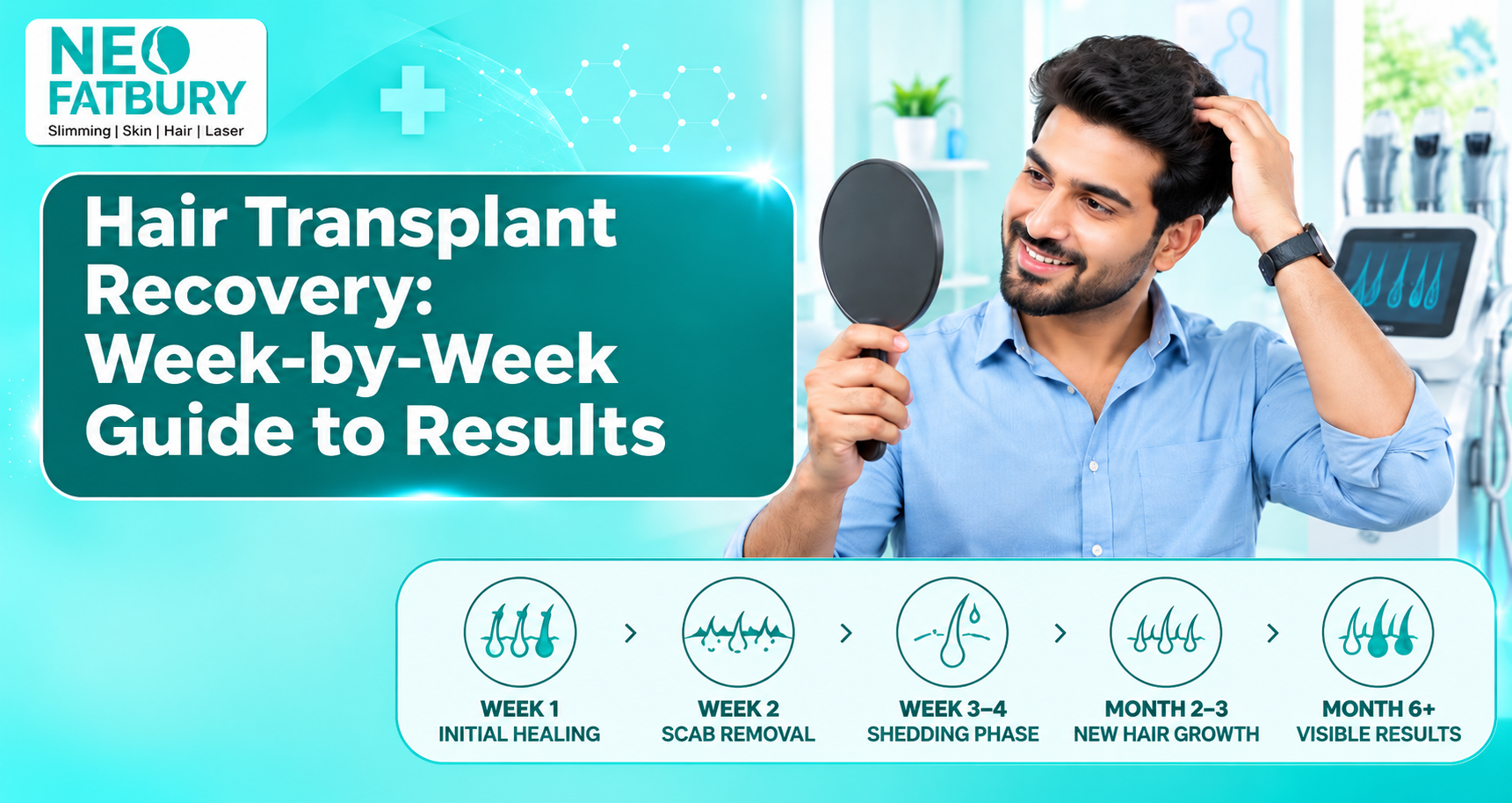
The first month is primarily about protecting the transplanted follicles and allowing the scalp to heal. The following timeline explains the changes you may notice and the care required at each stage.
Week 1: Initial Healing and Scalp Protection
The first seven days are the most delicate part of the recovery process. The recipient area may appear red, with tiny scabs forming around the transplanted grafts. Mild swelling, tenderness, itching, and tightness are also common.Some patients experience swelling around the forehead, which can occasionally move towards the eyelids. This generally settles as the initial healing progresses.What you may experience:– Small scabs around the transplanted hair follicles.– Mild redness and scalp sensitivity.– Slight swelling around the forehead.– Tenderness in the donor area.– Occasional itching as the skin begins healing.Keep your head protected and avoid touching, scratching, or rubbing the transplanted area. Follow the washing schedule provided by your surgeon. Depending on your procedure, you may be instructed to use a prescribed saline spray or gentle cleansing method.Sleeping with your head slightly elevated may help reduce swelling if recommended by your doctor. Avoid strenuous exercise, excessive sweating, and activities that could accidentally cause pressure or impact to the scalp.The first week is not the time to judge the cosmetic outcome. Your priority should be protecting the grafts while the skin recovers.For additional medical information about hair transplant recovery, healing, and expected outcomes, refer to the MedlinePlus Hair Transplant Guide.”
Week 2: Scab Removal and Visible Healing
By the second week, most patients notice considerable improvement in scalp sensitivity and swelling. The small scabs surrounding the transplanted follicles begin loosening and gradually disappear.Redness may still be visible, especially in people with sensitive skin or lighter skin tones. The donor area also continues to recover, although its appearance depends on whether FUE or FUT was performed.What you may experience:– Scabs gradually fall away.– Reduced swelling and discomfort.– Less sensitivity around the donor area.– Mild itching or dryness.– Some transplanted hair shafts are beginning to shed.Continue following your clinic’s washing instructions. Never pull off scabs forcefully, as premature removal can irritate healing tissue. Your surgeon may allow gentle washing techniques to remove remaining crusts.You may be able to resume desk-based work or routine activities, depending on your comfort and the nature of your job. However, avoid returning to strenuous workouts without medical clearance.By the end of the second week, the scalp often looks significantly more settled. This does not mean that the final hair growth has started.
Week 3: Understanding the Shedding Phase
The third week can be confusing because some patients notice that transplanted hairs are falling out. This is commonly called shock shedding or postoperative shedding.Although it may look like the transplant is unsuccessful, shedding of the visible hair shafts is generally a normal part of the process. Hair Transplant Recovery: Week-by-Week Guide to Results The transplanted follicles usually remain beneath the skin and enter a resting phase before producing new strands.What you may experience:– Noticeable shedding of transplanted hair.– Reduced redness and scabbing.– A more natural-looking scalp surface.– Occasional itching or mild sensitivity.– Temporary changes in the appearance of hair density.Maintain a gentle hair-washing routine and avoid aggressive brushing or scratching. Follow your surgeon’s instructions regarding exercise, swimming, hair products, and sun exposure.Do not start hair growth medications or apply oils and chemical treatments without consulting your treating doctor.The shedding phase can affect confidence, particularly when you were expecting immediate improvement. Remember that the transplanted follicles need time to restart their natural growth cycle.
Week 4: The Beginning of the Resting Phase
By the fourth week, much of the initial healing is usually complete. Many transplanted hair shafts may have fallen out, leaving the recipient area looking similar to its pre-transplant appearance.Hair Transplant Recovery: Week-by-Week Guide to ResultsThis stage is sometimes called the resting phase because the follicles are temporarily inactive. The absence of visible growth does not necessarily indicate a problem.What you may experience:– Most initial scabs have disappeared.– The scalp looks more settled.– Transplanted hair shedding may continue.– The donor area becomes less noticeable.– Hair density may temporarily appear unchanged.Continue maintaining scalp hygiene and attend scheduled follow-up appointments. Your surgeon may advise when you can gradually return to normal exercise, shampooing, and styling routines.Avoid comparing your appearance with other patients. The number of grafts, surgical technique, individual hair cycles, and healing characteristics can all influence the recovery experience.At this point, patience is particularly important. The follicles are preparing for the next stage of growth, even when visible changes are limited.
Hair Transplant Recovery: What Happens Between Months 2 and 6?
Hair Transplant Recovery: Week-by-Week Guide to Results After the initial healing period, the focus gradually shifts from scalp recovery to new hair development. This is when patients begin looking for visible improvements, although growth remains gradual.
Month 2: The Waiting Period
During the second month, most patients experience little noticeable hair growth in the transplanted region. Some may continue experiencing shedding, while others notice small changes in scalp texture.The follicles are generally in their resting stage, and there may be no significant cosmetic improvement yet.This period can feel disappointing, especially if you expected a quick transformation. However, Hair Transplant Recovery: Week-by-Week Guide to Results should be understood as a gradual biological process rather than an immediate cosmetic change.Continue following the aftercare plan, eat a balanced diet, and avoid experimenting with unapproved hair growth products. Your doctor may recommend appropriate treatment to manage existing hair loss outside the transplanted area.
Month 3: Early Signs of New Hair Growth
The third month is an important milestone for many patients. Some transplanted follicles begin producing new hair strands, although the initial growth may be fine, thin, and uneven.The new hairs may appear lighter or softer than the surrounding natural hair. Different follicles become active at different times, so the growth pattern may not look uniform.What you may notice:– Small, fine hairs emerging from the scalp.– Uneven growth across the transplanted region.– Slight improvement in hairline appearance.– Continued differences in hair thickness.Take photographs under consistent lighting to track progress. Daily mirror checks can make gradual changes difficult to recognise.
Month 4: Gradual Improvement in Coverage
By the fourth month, more transplanted follicles may begin producing visible strands. The hairline may start looking more defined, and some patients notice improved coverage in previously thinning areas.However, the new hair can still be thin and relatively short. Full density should not be expected at this stage.Hair Transplant Recovery: Week-by-Week Guide to Results also highlights why individual growth patterns matter. Someone who begins seeing new hairs at month three may develop visible coverage earlier than another patient whose follicles take longer to enter the growth phase.Your surgeon can evaluate the progress during follow-up appointments and determine whether the healing and growth pattern are appropriate.
Month 5: Increasing Hair Length and Thickness
During the fifth month, newly growing hair may become more noticeable. Individual strands gradually increase in length, and the transplanted region can begin blending with surrounding hair.Some patients experience improved coverage, while others may still notice gaps or uneven density.The appearance depends on several factors, including graft survival, hair characteristics, donor hair quality, and the size of the treated area.Continue maintaining a healthy scalp routine and avoid unnecessary chemical treatments.Hair Transplant Recovery: Week-by-Week Guide to Results If you have concerns about slow growth, discuss them during your follow-up consultation rather than assuming that the transplant has failed.
Month 6: A More Noticeable Transformation
The sixth month is often when patients begin noticing a more meaningful cosmetic improvement. Hair coverage becomes increasingly visible, and the newly growing strands may develop greater thickness.The transplanted hairline can look more natural as additional follicles enter the growth phase. However, the result is still developing, and density may continue improving over the following months.At this stage, your surgeon can assess the progress using comparison photographs and examine the density, direction, and distribution of the growing hair.A six-month assessment is useful for understanding progress, but it should not be considered the final result.
Hair Transplant Recovery: Months 7 to 12 and Beyond
The second half of the first year is generally associated with continued hair growth, increasing thickness, and improved cosmetic blending.
Months 7–8: Improved Hair Coverage
Between months seven and eight, many patients notice that their transplanted hair is becoming longer and more substantial. The overall appearance may look fuller, particularly around the frontal hairline and crown, depending on the treated region.Hair Transplant Recovery: Week-by-Week Guide to Results The hair begins blending more naturally with existing strands. Styling may also become easier as the length increases.However, the crown area can take longer to show noticeable improvement because of its hair-growth pattern and natural density characteristics.
Months 9–10: Greater Density and Natural Appearance
By months nine and ten, the cosmetic improvement is often more evident. More follicles have entered active growth, and the transplanted strands may develop a texture and thickness closer to the surrounding hair.The hairline generally looks more settled, and the overall coverage can become more consistent.For many patients, this is an encouraging stage because the difference between the initial appearance and current results becomes easier to recognise.
Months 11–12: Approaching the Mature Result
Around the one-year mark, many patients have achieved a substantial portion of their expected hair transplant results. The transplanted hair has had more time to grow, thicken, and blend with existing hair.Some individuals may still experience continued improvement beyond 12 months, particularly in the crown region. Final maturation can take 12–18 months depending on the procedure and individual characteristics.The one-year consultation is a good opportunity to evaluate the overall result, discuss remaining concerns, and understand whether any additional treatment is appropriate.Hair Transplant Recovery: Week-by-Week Guide to Results makes one point clear: the first few weeks show healing, while the following months reveal the actual cosmetic transformation.Hair Transplant Recovery Timeline at a Glance
FAQ’s
How long does hair transplant recovery take?
Hair Transplant Recovery: Week-by-Week Guide to Results Initial scalp healing generally takes around 10–14 days. However, complete hair growth takes considerably longer. New growth may begin around months three to four, while mature cosmetic results can take 12–18 months.
Is hair shedding normal after a hair transplant?
Yes. Temporary shedding of transplanted hair shafts is common during the first few weeks. The follicles generally remain beneath the skin and can produce new hair after their resting phase.
When can I wash my hair after a hair transplant?
The washing schedule depends on the surgical technique and your surgeon’s instructions. Some patients may begin gentle washing within the first few days. Avoid rubbing or applying pressure to the transplanted area until your surgeon confirms it is safe.
When will I see visible hair growth after a transplant?
Some patients notice fine new hair around the third or fourth month. More noticeable density often develops between six and nine months, with continued improvement over the following months.
When can I expect final hair transplant results?
Many patients see substantial results around 12 months. However, additional growth and maturation can continue until 18 months, particularly in certain treatment areas such as the crown.











 Make An


 +91 7730049777
 neofatbury@gmail.com